Monday, 24 November 2014
Locations used to shoot music video
Field
I want my video to feature a field as I think it will portray the loneliness that the song represents as she will look isolated against the rest of the world and show how she is 'waiting for nothing'. I also think that it will look good as the field has a tree that I would like to include in my shot. I also think that having a different variety of shots will look good as the scenery in the background will look good.
Dark room
I think that the dark room will also promote the loneliness that the song is trying to get across. The effect I want is for her to look like there is literally nothing for her to wait for and that she is the victim in the situation. I also think it allows her to get emotions across as it makes us focus completely on her as she will be the only one in the shot.
Alley way
I think the alley way will make it look like everyday life has been interpreted into the video as the song is about actual emotions that the artist who the song is actually by felt and it creates the normality of things people actually feel.

Tuesday, 18 November 2014
Representation Theories
Laura Mulvey- Male Gaze theory
- States how the audience views women who are presented in the media.
- States that the women are there to be seen and that the use of camera portrays them as sexual objects.
Focus:
- How men look at those images
- How women look at themselves from those images
- How women look at other women (do they see them as unrealistic ideologies and are they supposed to conform?)
- Emphasising curves of the female body
- Referring to women as objects rather than people
- The display of women is how men think they should be perceived
- Female viewers view the content through the eyes of a man
This theory describes how the audience or viewer is put into the perspective of a heterosexual male and how the camera uses particular movements to present women in an idealistic way. The man emerges as the dominant power within the created film fantasy and it states that the film gaze with women and men is the same because women look at themselves through the eyes of a man.
Summary:
- Music videos emphasise curves of the female body
- Music videos show women as objects rather than people
- Music videos display women in a way to please men
- Females view them in the same way as men
Music videos that support this theory
Richard Dyer- Star theory
'To be a star you have to have certain qualities'
'Stars are commodities that are produced by institutions'
'A star is a constructed image, represented across a range of media and mediums'
'Stars represent and embody certain ideologies'
- It is the idea that icons and celebrities are constructed by institutions for financial reasons and are built to target a specific audience or group of people
-Audience and institutions
-Constructions
-Hegemony (cultural beliefs)
This theory says that stars are fake and their job is to be looked at and to make money from.
- Audiences and Institutions
-stars are made to make money and for that purpose alone.
-audiences want to consume what they think/are made to think is ideal.
-institution modifies the stars image around the target audience.
-a star is made based on what the audience want.
- Constructions
-a star is built for an audience and is not an actual person.
-a persona is created to identify with so stars can differentiate between different stars.
-they are built with someones signature to them
- Hegemony
-we relate to a star because they have a feature we admire or share with them.
-some people may attempt to replicate them which could be negative.
'A star is an image, not a real person, that is constructed (as any other aspect of fiction is) out of a range of materials (e.g. advertising) magazines etc as well as films and music' 1979
Stars that support this theory:
Katy Perry Beyonce


Stars that support this theory:
Katy Perry Beyonce
Tessa Perkins- Stereotypes
What is a stereotype?
Someone who is prejudged on their looks or by what they do and then put into a group because they have similarities, based on characteristics, expect them to have certain ideologies and beliefs.
Why do we stereotype others?
-to identify what someone is like (prejudge)
-because the media puts ideologies in our minds
-to understand people we might not come in contact with
Stereotypes are assumptions we make on groups of people.
Stereotyping is not a simple process and contains a number of assumptions that can be challenged:
Perkins identified 5 assumptions
Why do we stereotype others?
-to identify what someone is like (prejudge)
-because the media puts ideologies in our minds
-to understand people we might not come in contact with
Stereotypes are assumptions we make on groups of people.
Stereotyping is not a simple process and contains a number of assumptions that can be challenged:
Perkins identified 5 assumptions
- Stereotypes are not always negative
- They are not always about minority groups
- They can be held at ones own group
- They are not rigid or unchanging
- They are not always false
Stereotypes are not always negative:
People always assume they're negative
e.g. troublesome youths 'hoodie culture' however youth can also be seen as postive (good in exams)
Not always about minority groups:
we can make assumptions about the upper class
e.g. prime minister
Held about ones own group:
People judge people within their own groups
People judge people within their own groups
e.g. we all want to be at wyke to get good grades, however within our own group of people there will still be stereotypes (emos, goths etc.)
Rigid or unchanging:
Once it has been created it is hard to change as changing a mass audiences point of view is difficult to change, however they develop through time
e.g. homosexuality used to be seen as 'weird' and 'abnormal' but now it is legal and people are less judgmental
Not always false:
We witness and read stories in the media to shape our minds and understandings. We may witness it first or second hand however there must be some truth in a stereotype otherwise the ideology behind them would not have existed in the first place
e.g. emo's are thought to listen to heavy metal and smoke etc and many 'emo's' do
Implications of stereotypes:
e.g. homosexuality used to be seen as 'weird' and 'abnormal' but now it is legal and people are less judgmental
Not always false:
We witness and read stories in the media to shape our minds and understandings. We may witness it first or second hand however there must be some truth in a stereotype otherwise the ideology behind them would not have existed in the first place
e.g. emo's are thought to listen to heavy metal and smoke etc and many 'emo's' do
Implications of stereotypes:
- Stereotypes are not always erroneous in context (usually wrong)
- They are negative concepts
- They are about groups with whom we have little or no social contact; by implication therefore they are not held about ones own group
- People either hold stereotypes of a group or don't. This can lead to negative behaviour towards a member of that group can be predicted
- Because someone holds a stereotype of a group, his or her behaviour towards a member of that group can be predicted
- Stereotypes are an invaluable aid to understanding the world and all stereotypes must have a bit of truth
Monday, 3 November 2014
Target Audience Profile

Doing this shows who my expected target audience will be and how I will try to incorporate the interests of this girl into my own products. This means that I can concentrate on appealing to people who are more likely to buy the products from my artist, rather than a wide audience who it may not necessarily be interested in the product enough in order to buy it, and the music industry nowadays is mainly about money.
Monday, 20 October 2014
Music Video Treatment
Setting will be a dark empty room and a field. Lighting will be dim with spotlight on her. Clothing will be black. She will Lip sync and perform, some of it playing guitar. Editing will be black and white, some slow motion, rewind, fast.
Saturday, 18 October 2014
Audience Research
The first thing I did when gathering research on what to include in my music video was ask a random selection of people at my college the following questions:
- Gender
- Age
- What conventions do you expect to see in a pop-punk music video?
- What bands have you heard of that fall under the genre of pop-punk?
- If you have watched any pop-punk music videos, what did you like about them? If not, why haven't you watched any?
- If you were making a pop-punk music video what would you include in it? Why?
I thought that asking the gender of the audience was appropriate so that I can see what appeals to both male and female. It also gave me more ideas as both genders came up with different things.
I thought that asking the age of the audience was appropriate because it told me whether or not college students watch music videos which gave me an idea on the age of my target audience.
I thought question 3 was appropriate as it gave me a stereotypical idea on what people expect to see in pop-punk music videos as the conventions used in music videos are what define the genre of them.
I thought question 4 was relevant because it shows me who the most popular pop-punk artists are and gives me ideas on what artists to use for my research.
Question 5 is relevant because it gave me an idea on what people like and don't like about music videos and what to include in my own music video so that it will attract my target audience.
Finally, I asked question 6 so that I could get ideas from the audience and potentially use them in my own music video to attract my target audience.
Here are my results:
Friday, 17 October 2014
Hair and Makeup Research
The first thing I did when I started my hair and makeup research was do 2 mood boards- one on hair and one on makeup. I feel this helped me a lot because it gave me different ideas to try out in order to give my actress the right look. I think that hair and makeup is important in music videos as it allows the audience to identify the genre and it also accentuates the desired part of the face to create a certain affect.

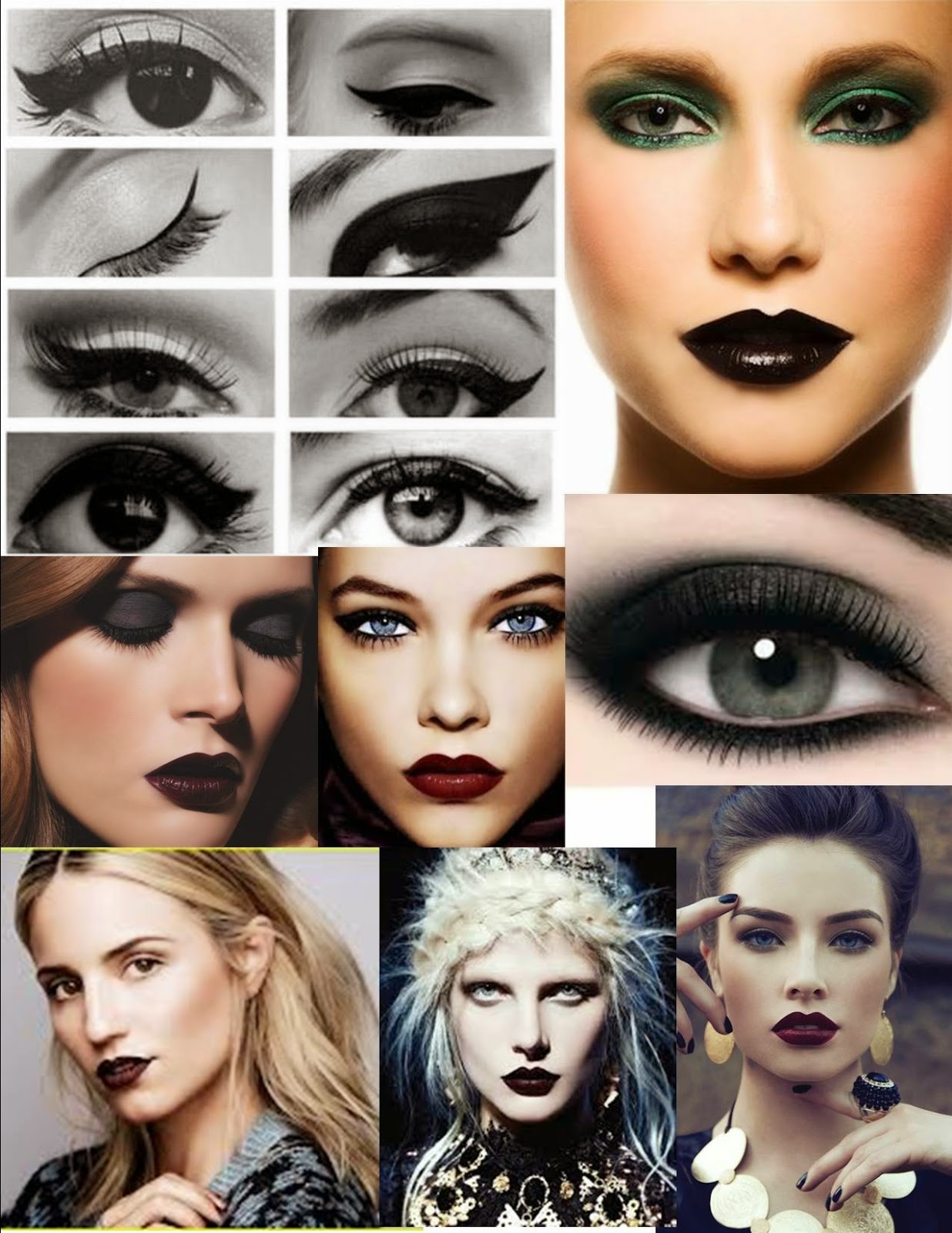
After I finished my mood boards I thought it would be a good idea to look on YouTube and see what tutorials come up to ensure that I expand my knowledge on different ways of doing makeup.
I think this video is helpful because the end look is something that creates the desired affect that I am looking for.
Costume Research
The first thing I did to get an idea of what clothing my actress was going to wear was go on Google and search pop-punk. I did this to see the general idea of what the world thinks pop-punk is and it also creates a sense of stereotyping.


The next thing I did was search 'how to dress pop-punk' on YouTube to get some more inspiration on how to dress my cast. I feel that it is important to get a lot of research on costume because I think it is the most important element in a music video to show what genre it is.
Subscribe to:
Posts (Atom)